How Tag Management Drives Trustworthy Marketing Analytics

Written by Macee Rea, Digital Operations Manager
Most digital marketing teams only discover broken tags when revenue drops or conversions flatline. The scramble to fix signals might feel like a quick technical cleanup, but it's often a symptom of deeper technical debt that creates a quiet drag on performance.
Tags are the connective tissue and translation layer of modern marketing data collection and tracking; they turn customer behavior into actionable strategic moves. Powering everything from ROAS to attribution, every optimization, creative pivot or budget shift depends on these incoming signals. When this feedback loop degrades, even the best creative and media plans end up flying blind because they are based on distorted inputs.
Reliable tracking isn’t just an analytics concern; it’s an operational necessity. To replace guesswork with proof, strong tracking infrastructure must standardize data, minimize redundancy and anticipate change.
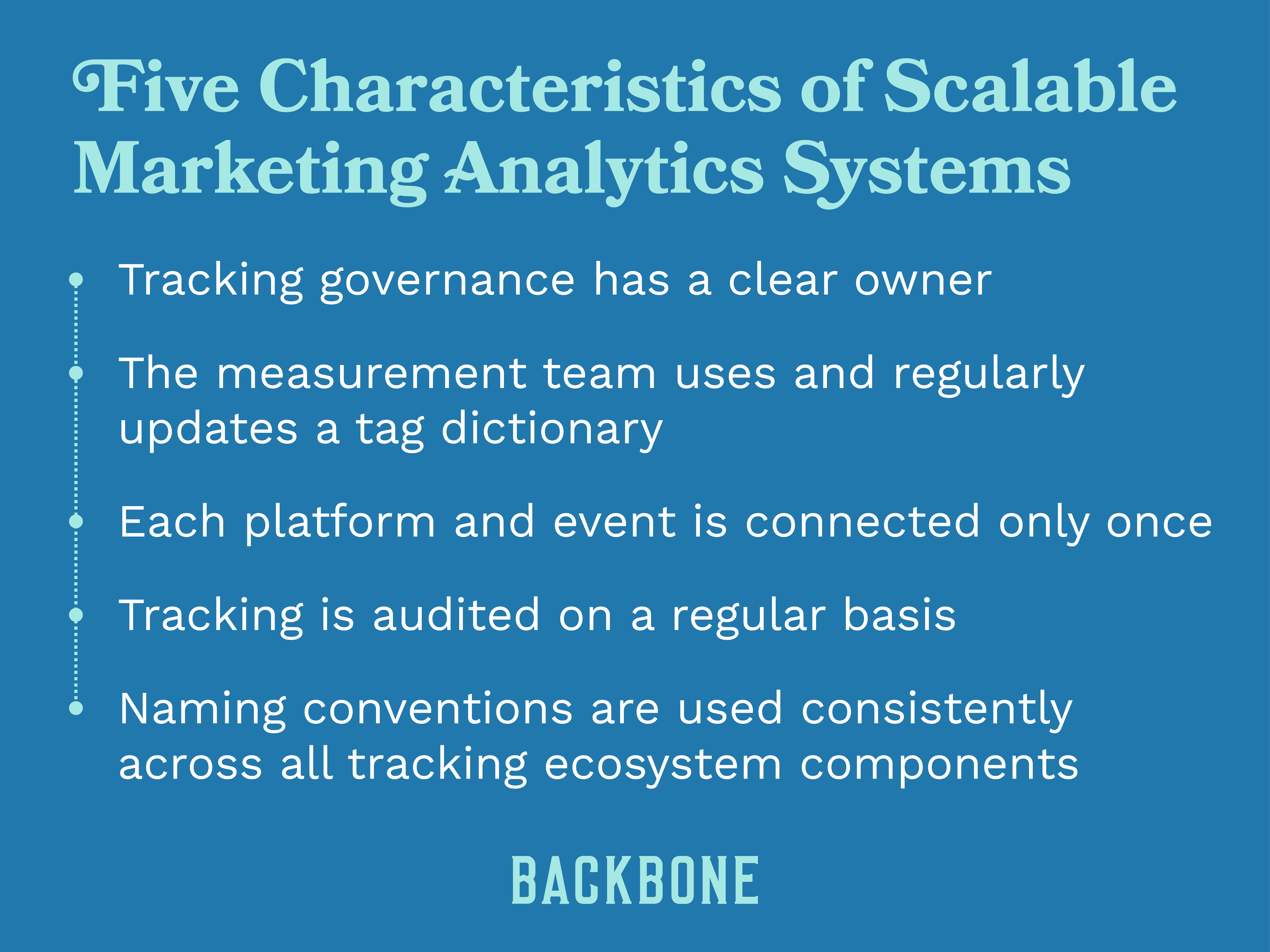
Achieving this foundation requires a systematic approach to building your marketing analytics ecosystem. The five essential traits below show how these outcomes are delivered in practice.
Are you tired of broken marketing data? Read on to learn more about how to build trustworthy, resilient tracking you can actually rely on, or reach out to us at Info@Backbone.Media to see how Backbone can help.
Five Characteristics of Scalable Marketing Analytics Systems
1. Tracking governance has a clear owner
Governance determines whether measurement accumulates technical debt or builds operational leverage. Without clear ownership, tracking decisions are made opportunistically by whoever touches the system last, leading to fragmented logic and undocumented exceptions. Centralized authority preserves standards and allows the system to anticipate change rather than reacting to it.
Strategic recommendations:
- Assign a primary owner or small group responsible for tracking decisions
- Define escalation paths for changes
-
Align analytics, marketing, and development around that ownership system
2. The measurement team uses and regularly updates a tag dictionary
A tag dictionary is the centralized internal reference that ensures analysts, marketers and developers are all speaking the same language. By documenting every tracked event and parameter, brands standardize how data is interpreted and dramatically reduce onboarding time and QA cycles.
Strategic recommendations:
- Define every event, parameter, and firing condition in plain language
- Document where it fires, why it exists, and which platforms receive it
-
Maintain it as a living document
3. Each platform and event is connected only once
Duplicate connections, like multiple connections for the same platform pixel, inflate conversion counts and distort attribution. Ensuring a single connection point per platform minimizes redundancy and conflict between platforms.
Strategic recommendations:
- Use one base pixel per platform
- Ensure one connection point for each pixel and event
- Establish clear documentation of where connections live (GTM, native integrations, or custom code)
What to avoid:
- Multiple pixel implementations for the same platform (e.g. GTM tags plus a site plugin)
- Legacy tags left “just in case”
-
Uncoordinated platform-side integrations layered on top of GTM
4. Tracking is audited on a regular basis
Measurement systems aren’t “set-it-and-forget-it.” Browsers change, consent requirements shift and site development is constant. Regular audits prevent small drifts from becoming systemic failures, ensuring infrastructures anticipate change effectively.
Strategic recommendations:
- Perform lightweight, quarterly audits for core events and general health
- Conduct deeper reviews tied to major site releases or platform changes
-
Proactively validate data after introducing new tools or partners
5. Naming conventions are used consistently across all tracking ecosystem components
Standardized naming is key to data discoverability at scale. Consistent, human-readable conventions foster a self-service analytics culture, allowing marketing and leadership teams to validate assumptions and act quickly without needing a translation for every report.
Strategic recommendations:
- Use clear, human-readable names
- Implement predictable parameter structures
-
Maintain consistency across all platforms and tools
A More Durable Approach to Tag Management
When tracking is designed with system-level thinking, measurement remains usable even as regulations and expectations evolve. An intentional approach reduces operational risk and prevents measurement issues from becoming performance blockers.
Let Backbone's Analytics team help your brand design a resilient tracking system that replaces the drag of unreliable data with sustained performance gains.
